Technical Data



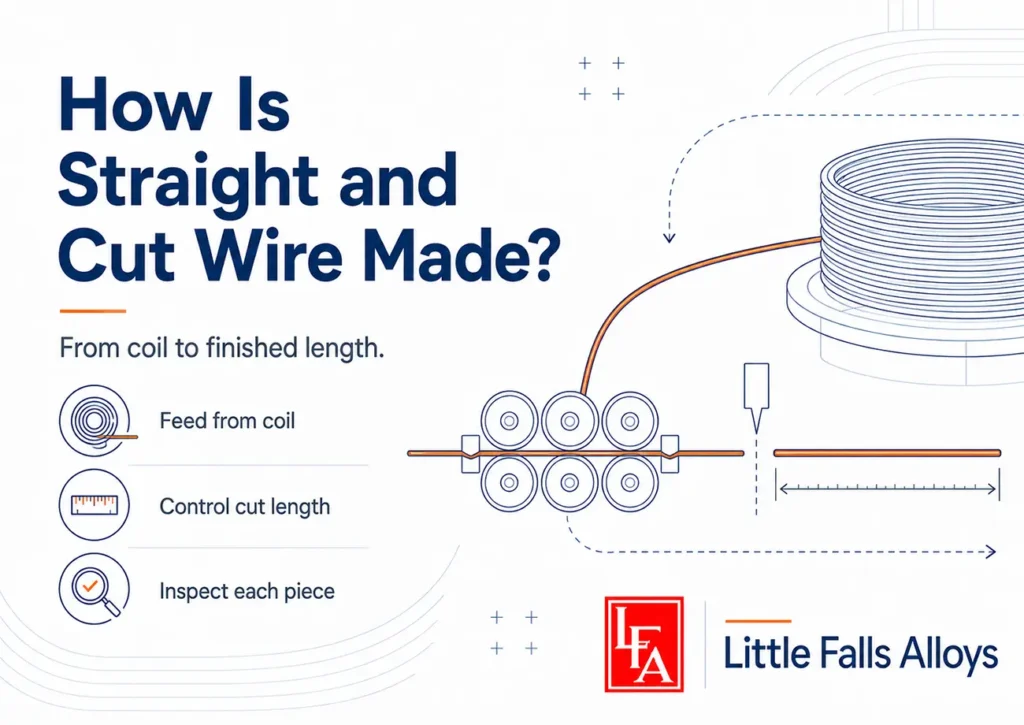
Straight and cut wire is produced by taking continuous coiled wire, removing unwanted curvature, advancing a controlled amount of material, and cutting it to the required finished length. Although the sequence is straightforward, the quality of the finished piece depends on more than just the cutting operation. Feeding controls how the material moves through the machine; straightening corrects curvature; measurement establishes length; and cutting creates the finished end. At LFA, we control these stages as a single manufacturing process because variation at any stage can affect the dimensions and condition of the final piece. The process succeeds when the completed wire consistently meets the required length, straightness, and end condition.
The Process Begins With Coiled Wire
Coiling makes continuous wire practical to store, ship, and feed into manufacturing equipment. Still, it also leaves the material with curvature that must be corrected before straight lengths can be produced. Research on industrial wire straightening identifies cast and helix as curvature conditions associated with coiled wire and describes straightening as the process used to remove or modify them. That means straightening is not the final cosmetic step. It changes the geometry the wire carries from the coil so the material can be produced as individual straight pieces.
The amount of correction required depends on the incoming wire. Diameter, alloy, temper, prior processing, and the amount of coil set can all affect how the material responds as it enters the straightener. Harder or higher-strength wire does not necessarily react the same way as softer material under the same machine settings. The process therefore begins by accounting for the actual condition of the wire being run rather than treating every coil as interchangeable.
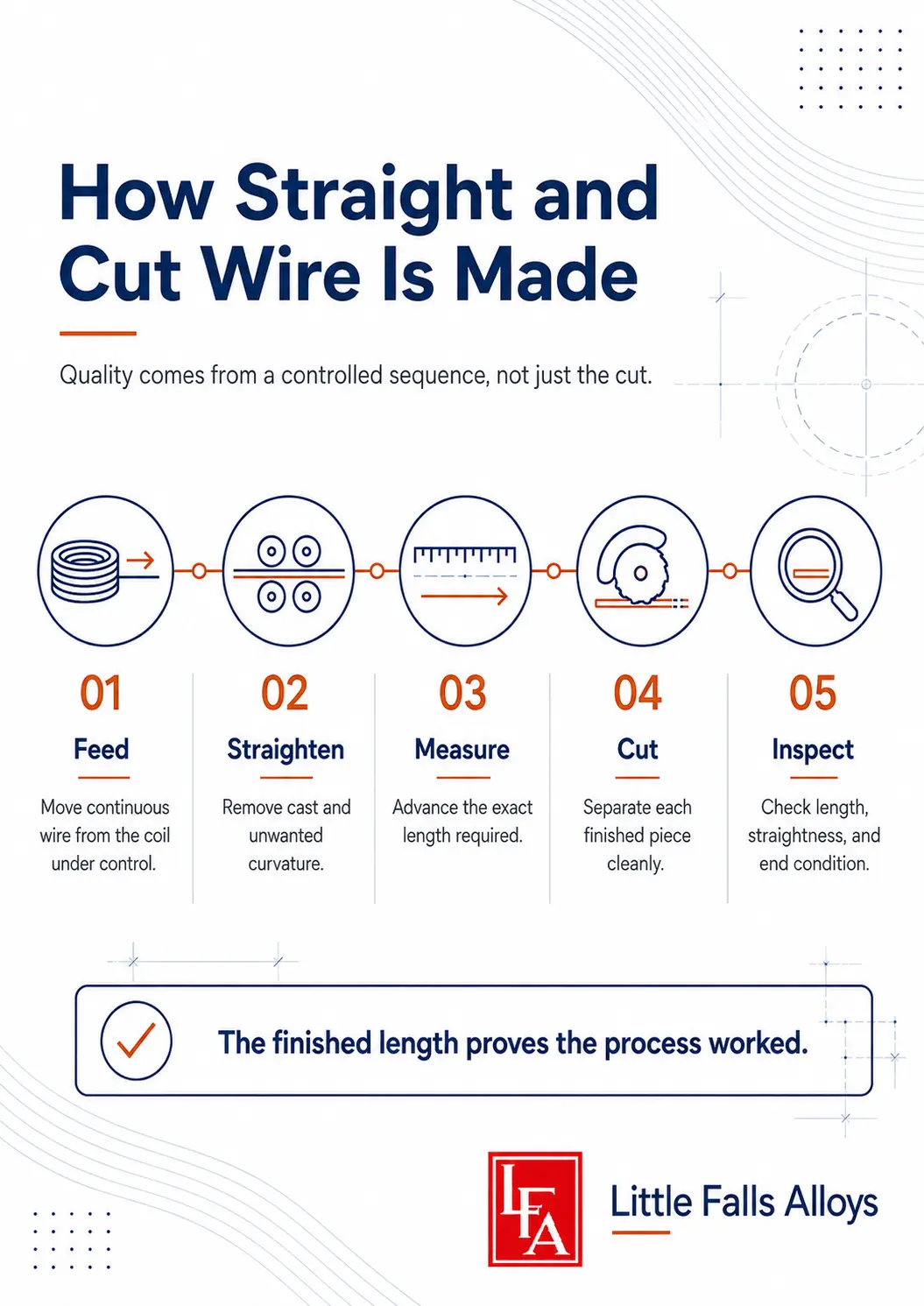
Feeding Establishes Control before Straightening
The feed system controls how the wire moves from the coil into the straightening equipment. This movement must remain consistent because every subsequent operation depends on the wire advancing predictably. Research on high-strength wire straightening has shown that irregular feeding can disturb the process to the point that tension control is used to mitigate its effects. Feeding is therefore part of process control, not merely a method for pulling material through the machine.
The contact between the feed components and the wire also has to suit the material being processed. Too little control can lead to inconsistent movement, while excessive or poorly adjusted pressure can damage the wire surface. Diameter, temper, and surface condition all influence how the material should be handled. At LFA, stable feeding provides the controlled starting point required for the straightening and measuring operations that follow.
Straightening Removes Cast and Residual Curvature
Straightening changes the geometry of the wire through controlled deformation. In roller straightening, the material passes through a sequence of rollers that repeatedly bend it, progressively reducing the curvature carried from the coil. Published research on industrial straightening shows that residual stresses and prior deformation can affect final product quality, underscoring the importance of straightener adjustment. The rollers are not simply forcing the wire into a straight line; they are correcting the material’s tendency to return to its previous shape.
The amount of correction has to be appropriate for the wire. Too little adjustment can leave visible camber or residual curvature in the finished piece, while an unsuitable setup can overwork the material or affect its surface. Diameter, temper, alloy, and starting curvature all influence how the wire behaves as it passes through the rollers. The required finished straightness determines whether the adjustment is sufficient. At LFA, the straightener is set around that finished requirement rather than around one fixed machine setting.
Measurement Controls the Finished Length
Once the wire is feeding consistently and leaving the straightener under control, the machine must determine how much material advances before each cut. This is the point where continuous wire begins to become a repeatable cut-to-length product. The U.S. Patent and Trademark Office classifies straightening-and-cutting equipment as machinery for producing straight wire in predetermined lengths, reflecting how central measurement is to the process. A cutting machine cannot produce consistent finished pieces if the amount of material advanced varies from cycle to cycle.
The required tolerance determines how tightly that movement needs to be controlled. A nominal length alone does not fully define the finished part, as every manufacturing process operates within an allowable dimensional range. A short component intended for a close-tolerance assembly can place different demands on the process than a longer piece with a broader acceptable variation. At LFA, the customer’s drawing or specification establishes the target. The machine is then set to produce against that actual finished dimension rather than a vague requirement for “precision.”
Cutting Establishes the Finished Piece
After the required amount of wire has advanced, the cutting operation separates the finished length from the continuous material. By this point, the wire should already be feeding consistently, straightened to the required condition, and positioned at the correct length. The cutter then has to separate the piece at the specified location without creating an unacceptable end. Cutting is therefore the final forming event in the sequence, not the entire straight-and-cut process.
The quality of the end can matter just as much as the overall length. Burrs, deformation, or an unsuitable cut profile can create fit or handling problems when the wire enters a later manufacturing operation or assembly. If the drawing controls burr condition, end geometry, or another cut characteristic, those requirements need to be considered along with length tolerance. A wire that measures correctly but has an unacceptable end is still not a conforming finished part.
The Process Has to Repeat Across the Production Run
Producing one acceptable length does not prove that a straight-and-cut process is under control. The machine continues to feed wire from the coil and repeat the same straightening, measuring, and cutting sequence for the required quantity. Research on wire straightening has shown that variations in incoming material properties and residual deformation can affect final quality throughout production. That makes repeatability a central part of the manufacturing problem.
A small inconsistency can persist throughout an entire run if it is not identified and corrected. Feed variation can affect length, an incorrect straightener setting can leave curvature in multiple pieces, and a cutting problem can reproduce the same end defect. The individual stages therefore cannot be evaluated independently. At LFA, the goal is consistent conformity from one finished piece to the next, not simply keeping the machine in operation.
What Each Stage Controls
Each stage has a primary responsibility, but the result of one operation becomes the starting condition for the next. This is why straight-and-cut wire should be treated as one controlled manufacturing sequence rather than as separate straightening and cutting tasks.
|
Stage |
What It Controls |
What Can Affect the Finished Wire |
|
Payoff and feed |
Stable movement from the coil |
Irregular movement or surface marking |
|
Straightening |
Cast, curvature, and straightness |
Residual curvature or excessive deformation |
|
Measurement |
Amount of wire advanced |
Finished-length variation |
|
Cutting |
Separation at the required point |
Length and cut-end condition |
|
Inspection |
Conformance to specification |
Detection of dimensional or surface problems |
A later operation cannot always correct a problem introduced early in the sequence. Measurement cannot compensate for wire that was not straightened correctly, and inspection cannot make a nonconforming piece acceptable after production. Each stage must produce the conditions required for the next stage to work properly. The finished wire reflects the combined control of the entire sequence.
Inspection Confirms the Finished Geometry
Inspection determines whether the process produced the specified wire. Length and straightness are central because they are the two geometric conditions the straight-and-cut process is designed to establish. Still, other characteristics may also matter depending on the application. LFA’s existing straight-and-cut information identifies customer dimensions and tolerances as the basis for the service. The inspection criteria should therefore come from the drawing or specification rather than from a generic definition of acceptable wire.
Depending on the job, inspection may include:
- Finished cut length and tolerance
- Straightness
- Wire diameter
- Surface condition
- Burr or cut-end condition
These checks also help identify where a process problem may have occurred. Length variation can point to feeding, measurement, or cutting, while residual curvature can point to the incoming wire or the straightening setup. Surface defects may originate during feeding, straightening, or cutting. Inspection closes the process by comparing the manufactured piece with the condition the customer required.
Material and Diameter Affect the Straightening Setup
The straightening process must be adjusted to account for the physical behavior of the wire as it passes through the machine. Research on wire straightening shows that residual stresses, plastic deformation, and variations in the incoming material can influence final quality and complicate machine adjustment. Diameter and temper also change how much force is required to bend the wire and how strongly it tends to recover toward its previous shape. These are direct process variables because straightening works by controlling deformation in the material.
LFA processes non-ferrous straight-and-cut wire from .005 to .045 inch in diameter and produces cut lengths from 1 inch to beyond 12 inches, depending on the job. That range covers substantially different wire sizes and finished requirements, so it would not make sense to run every order under the same setup. A small-diameter soft wire and a larger, harder material can require different feed pressure and straightener adjustment even when both ultimately need to be straight and cut. We set the process around the material being run and the dimensions the customer needs from the finished piece.
The Finished Length Is What Proves the Process Worked
A straight-and-cut operation is successful only when the finished pieces consistently meet the customer’s required dimensions and straightness. Feed control, straightener adjustment, measurement, and cutting all contribute to that result, which is why the process has to be set around the actual alloy, diameter, temper, length, and tolerance of the job. At LFA, we process non-ferrous wire from .005 to .045 inch in diameter and produce straight lengths from 1 inch to beyond 12 inches where the application allows. If you need straight-and-cut wire for a production component, send us the material, diameter, finished length, tolerance, straightness requirement, quantity, and any controlled end or surface conditions so we can evaluate the job against the finished-part specification.