Technical Data



Beryllium copper wire is used when a component needs corrosion resistance without sacrificing the strength required to maintain its shape, spring force, or mechanical performance. That combination makes the material useful in demanding electrical and mechanical applications, but describing it simply as “corrosion resistant” leaves out the conditions that determine whether it will actually perform as intended. Moisture, chlorides, chemical exposure, temperature, mechanical stress, dissimilar metals, and surface condition can all change the corrosion risk.
At LFA, we evaluate those conditions alongside the alloy and finish because corrosion performance has to be judged against the environment the finished wire will actually encounter. The real question is not whether beryllium copper can corrode, but whether the specified material and surface condition provide enough resistance for the application.
How Does Beryllium Copper Perform in Marine Environments?
Marine exposure is one area where beryllium copper’s corrosion resistance is well established. The Copper Development Association describes beryllium copper as having both high corrosion resistance and very good biofouling resistance in marine use. Its broader guidance on copper alloys in seawater also identifies protective film formation, velocity, sulfides, cavitation, stress-corrosion cracking, and biofouling as factors that can affect performance. The important point is that “seawater” is not one fixed environment.
Water chemistry and service conditions can change significantly from one marine application to another. Clean moving seawater, stagnant seawater, industrial brine, polluted harbor water, and salt-laden atmospheric moisture expose a component differently. The Copper Development Association specifically identifies velocity and sulfides among the conditions engineers should consider when selecting copper alloys for seawater service. As a result, we would not specify beryllium copper merely because an application is described as marine. The type and severity of exposure still need to be understood.
Chemical Concentration and Temperature Matter
Chemical exposure cannot be evaluated reliably from the chemical name alone. Corrosion behavior can change when concentration, temperature, exposure time, moisture, oxygen availability, or contamination changes. NIST’s corrosion work has specifically examined how metal composition, solution concentration, exposure time, and other electrochemical conditions affect metal-solution interfaces. That is why a broad statement such as “beryllium copper resists this chemical” can be misleading when the operating conditions are not defined.
Temperature warrants particular attention because the service environment may be substantially more aggressive at operating temperatures than under room-temperature reference conditions. Concentration can create the same problem: two solutions containing the same chemical can expose the wire in very different ways. The relevant question is therefore not simply what chemical is present, but how much is present and under what conditions the wire will see it. For applications involving process chemicals, those conditions should be established before the corrosion performance of the alloy is judged. This keeps the material decision tied to the real exposure rather than a generic compatibility list.
Mechanical Stress Can Change the Type of Failure
Corrosion becomes more consequential when the wire is also carrying mechanical stress. Stress-corrosion cracking is a distinct form of environmentally assisted failure in which stress and a corrosive environment act together rather than independently. ASTM G36, for example, is a practice for evaluating the stress-corrosion-cracking resistance of metals and alloys in a boiling magnesium chloride solution. The existence of dedicated SCC testing reflects an important engineering point: general surface corrosion and cracking under stress are not the same failure mechanism.
This distinction matters for the types of parts frequently made from beryllium copper. Springs, clips, contacts, relays, and similar components can remain under load for long periods while also encountering humidity, salts, or other environmental exposure. The Copper Development Association lists C17200 for many of these mechanically demanding applications and identifies corrosion resistance as one reason for its use. When we evaluate wire for a loaded component, we therefore need to understand both the environment and the mechanical requirement. Looking at only one can miss the way the component will actually fail.
Dissimilar Metals Can Create a Separate Corrosion Problem
A corrosion-resistant wire can still be part of an assembly that develops galvanic corrosion. The U.S. Department of Energy describes galvanic corrosion as an electrochemical process that occurs when dissimilar metals are in electrical contact in the presence of an electrolyte such as moisture containing dissolved minerals. Under those conditions, the more active metal becomes anodic and can corrode more rapidly. This means the behavior of the complete assembly can matter as much as the resistance of an individual wire.
The risk becomes relevant anywhere beryllium copper contacts another metal and moisture can bridge the connection. Saltwater, condensation, outdoor humidity, process fluids, and other conductive moisture can provide the electrolyte necessary for the galvanic cell. DOE guidance also notes that even dew and high humidity can supply moisture needed for corrosion. We therefore need to know what the wire will contact after it leaves our facility. A material can be appropriate on its own and still require additional consideration once it becomes part of a mixed-metal assembly.
Plating Changes Which Surface Meets the Environment
Plating can change corrosion performance because the deposited metal becomes the surface directly exposed to the environment. This can be useful when the base alloy provides the required mechanical properties, but the component needs different surface characteristics. LFA can plate non-ferrous wire with gold, silver, nickel, copper, and tin as part of our wire-processing capabilities. The selected finish should therefore be considered together with the environment rather than treated as a separate cosmetic specification.
A coating only provides its intended protection while the surface system remains appropriate for the service conditions. Wear, forming, surface damage, coating continuity, and subsequent processing can affect what is eventually exposed. That is particularly important for contacts, springs, and other components that move or flex during service. We look at the plating requirement as part of the corrosion problem when the finished component needs both the bulk properties of beryllium copper and a different exposed surface. The base alloy and plating each solve a different part of the requirement.
What Conditions Should Be Evaluated?
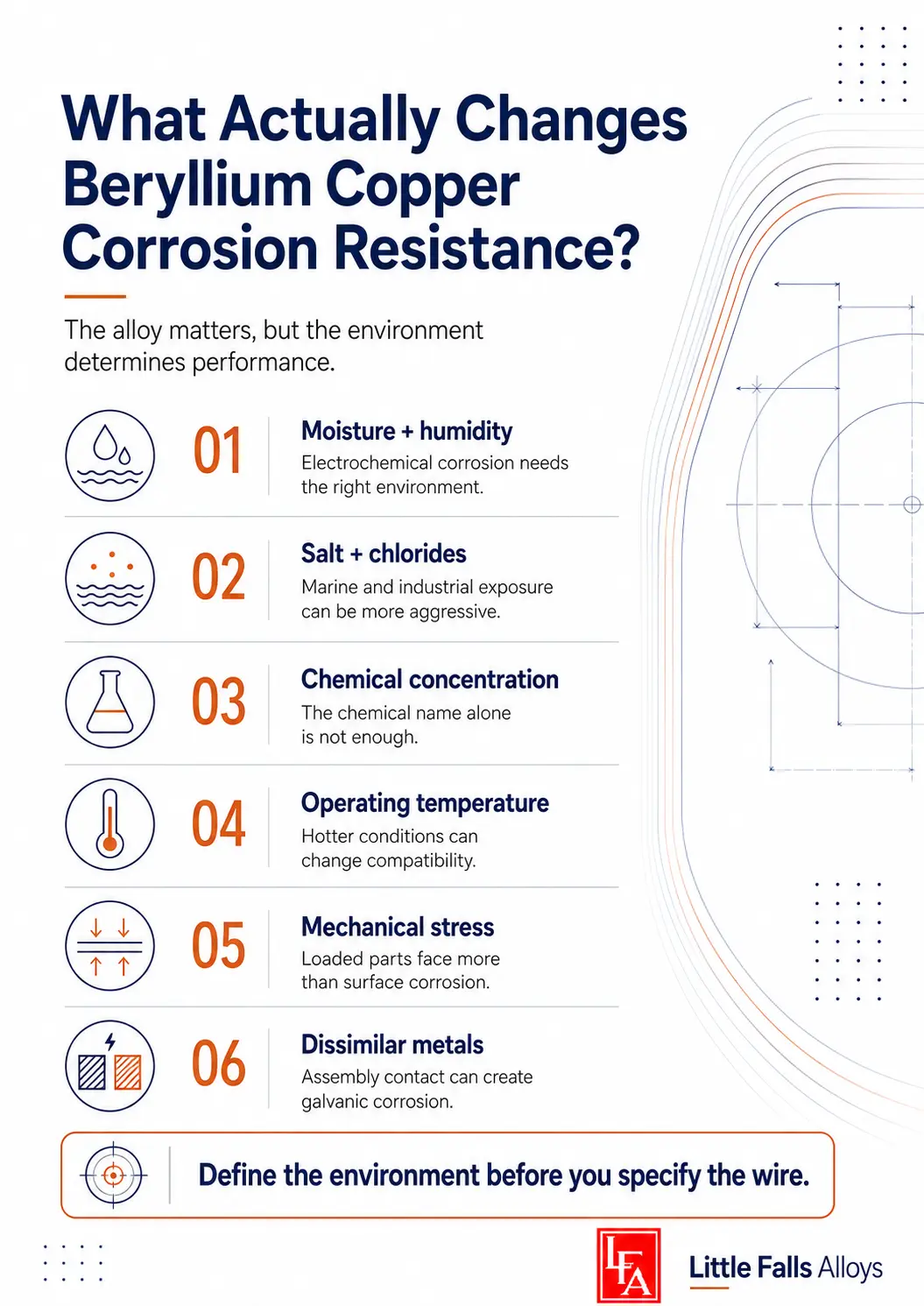
Several variables determine whether the corrosion resistance of beryllium copper wire is sufficient for a particular component. AMPP emphasizes that the environment, expected life, and the combination of materials in a system all influence corrosion behavior, rather than acting as isolated factors. For beryllium copper wire, the most important questions can be organized around the conditions below.
| Condition | Why It Matters |
| Moisture and humidity | Provide the environment required for many electrochemical corrosion mechanisms |
| Salt and chlorides | Increase the severity of many marine and industrial exposures |
| Chemical concentration | Changes how aggressively a solution interacts with the metal |
| Operating temperature | Can change corrosion behavior and chemical compatibility |
| Mechanical stress | May introduce environmentally assisted cracking concerns |
| Dissimilar-metal contact | Can create galvanic corrosion when an electrolyte is present |
| Surface finish or plating | Determines which metal surface is directly exposed |
| Required service life | Establishes how much degradation the component can tolerate |
No individual row determines the answer by itself. A wire operating under load in salt-contaminated moisture presents a different problem from the same alloy stored in a controlled indoor environment. Likewise, a plated component in contact with another metal creates conditions different from those of bare beryllium copper operating alone. The application must be evaluated under a complete exposure condition.
When Corrosion Resistance Has to Hold Up in the Real Application
Corrosion resistance matters only if the finished wire can maintain the properties the component depends on throughout its service life. For beryllium copper, that means evaluating the actual exposure conditions alongside the required strength, temper, surface condition, and any plating used on the wire. Salt, moisture, chemicals, temperature, mechanical stress, and dissimilar-metal contact can each change the corrosion problem, so those conditions should be defined before the material and finish are finalized. At LFA, we work with C17200 and C17300 beryllium copper wire and can incorporate drawing, plating, straightening, and cutting when those operations are part of the specification. If corrosion resistance is critical to your component, send us the environmental conditions, alloy requirements, dimensions, and surface-finish needs so we can review the wire-processing requirements around the application.