Technical Data



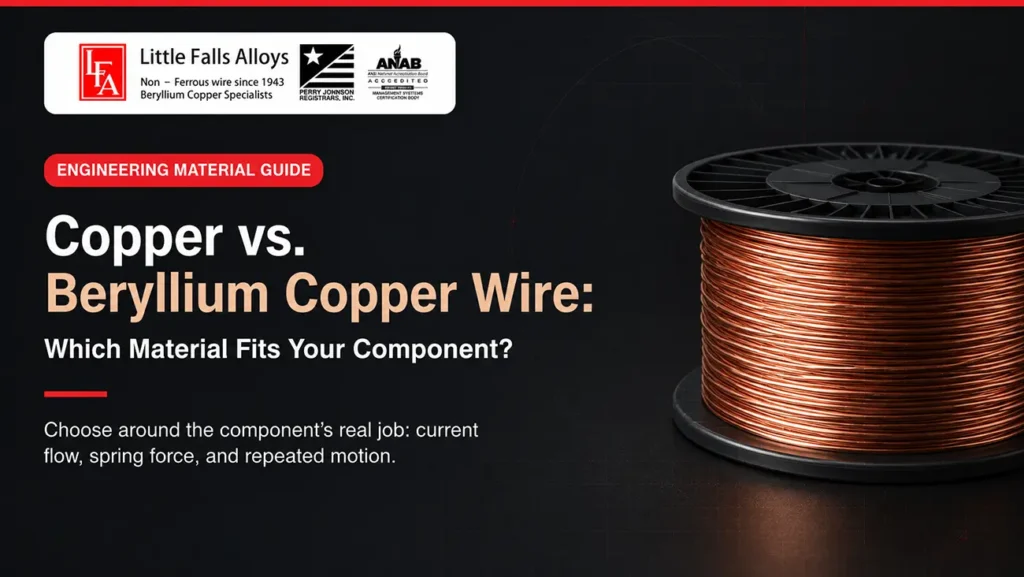
Electrical conductivity alone does not determine whether wire will perform inside a contact, spring, connector, or formed component. A material might carry the required current yet bend permanently, lose contact force, or fracture after repeated movement. Pure copper and beryllium copper both serve electrical applications, but each solves a different design problem. The correct choice starts with the mechanical job the wire must perform after entering the finished component. Treating both materials as interchangeable risks solving the conductivity requirement while leaving the component exposed to mechanical failure.
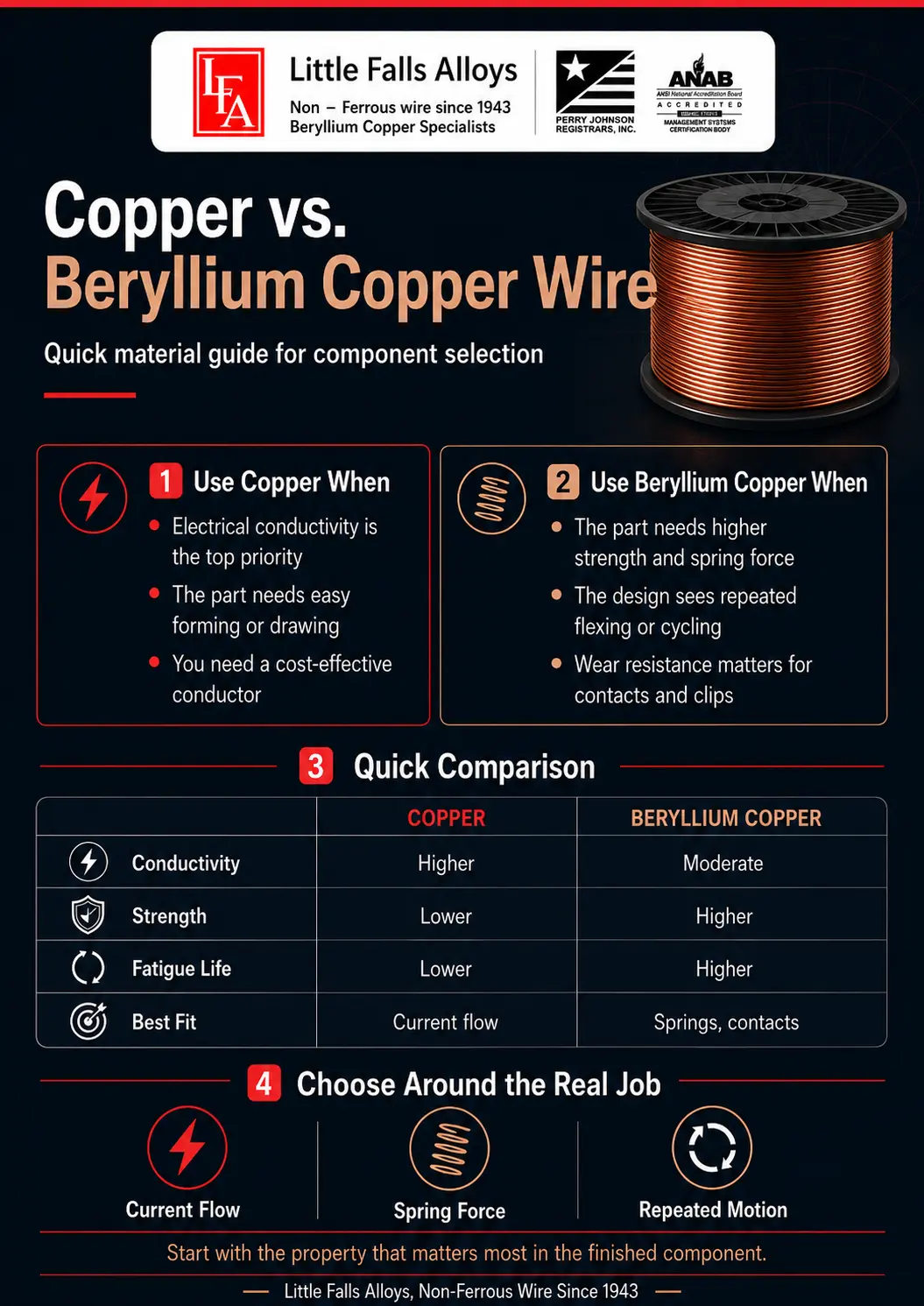
High-conductivity copper usually provides the stronger starting point when current flow or heat transfer controls the design. Beryllium copper becomes relevant when the same wire must also resist deformation, retain spring force, or survive repeated cycles. The added strength comes with a substantial reduction in conductivity. Neither material represents a universally superior choice. The specification needs to rank the importance of conductivity, strength, formability, fatigue, temperature, and production sequence for the finished part.
When High-Conductivity Copper Is the Better Fit
C10200 oxygen-free copper and C11000 electrolytic tough-pitch copper both provide high electrical conductivity. The Copper Development Association lists a minimum conductivity of 100 percent IACS in the annealed condition for both grades, with representative physical-property values of 101 percent IACS. IACS is a resistivity-based reference scale, not a claim of zero electrical resistance. C10200 contains at least 99.95 percent copper and no more than 0.001 percent oxygen, while C11000 contains at least 99.90 percent copper with process-dependent oxygen and trace content. The low oxygen level makes C10200 relevant when joining methods or service specifications require oxygen-free material, while C11000 remains a common fit for conductors, terminals, contacts, and related electrical parts. These grades make sense when conductivity and formability matter more than high spring strength.
High-conductivity copper generally fits applications where:
- The wire functions mainly as a stationary electrical conductor.
- Maximum current transfer takes priority over spring force.
- Repeated bending or deflection remains limited.
- Easy drawing, bending, or forming matters more than high tensile strength.
- The joining process or customer specification requires oxygen-free copper.
When Beryllium Copper Solves the Harder Problem
Beryllium copper accepts a substantial reduction in conductivity in exchange for far greater mechanical strength. Copper Development Association data lists precipitation-hardened C17200 and C17300 at approximately 22 percent IACS. For wire, C17300 reaches a representative tensile strength of 178 ksi in the TF00 precipitation-hardened condition and 212 ksi in the TH04 hard and precipitation-treated condition. C11000 wire, by comparison, reaches 55 ksi in hard H04 temper and 66 ksi in spring H08 temper. The difference explains why beryllium copper is used in current-carrying springs, electrical connectors, relay blades, clips, and contact bridges, where the component must conduct electricity while resisting permanent deformation.
Strength alone does not explain the value of C17200 or C17300. These alloys are also considered when repeated deflection, stress relaxation, and fatigue threaten the electrical interface. The Copper Development Association associates them with connectors and relay components because of their strength, fatigue resistance, and resistance to stress relaxation and thermal softening. A peer-reviewed study of C17200 found a decline in fatigue performance as test temperature increased, with the most severe reduction occurring at 450°C under the study conditions. The research does not establish one universal service-temperature limit because performance also depends on temper, load, surface condition, cycle count, and heat exposure. Beryllium copper provides a stronger mechanical platform, but the operating environment still belongs in the material specification.
C17200 or C17300 becomes relevant when:
- A contact must conduct current while maintaining spring pressure.
- The component repeatedly flexes and must return to its original position.
- Permanent deformation would change fit, force, or electrical continuity.
- Fatigue or stress relaxation threatens long-term performance.
- Final strength needs to increase through precipitation hardening.
Temper and Heat Treatment Control Forming Performance
The temperature determines whether beryllium copper arrives ready for final use or for additional forming and aging. ASTM B197/B197M covers C17200 and C17300 wire supplied in coils, spools, and other forms apart from straight lengths. The standard separates solution-treated, cold-worked, and precipitation-treated conditions. TB00 and TD00 through TD04 support production sequences where precipitation treatment follows forming, while TF00 and TH01 through TH04 arrive precipitation treated by the wire producer. This distinction affects bendability, spring forming, final strength, dimensional control, and the risk of cracking during downstream work. Specifying only “C17200 wire” leaves a critical gap, as the same alloy behaves differently before and after cold working and precipitation hardening.
Performance Trade-Offs by Material Family
|
Design priority |
C10200 or C11000 copper |
C17200 or C17300 beryllium copper |
|
Electrical conductivity |
Approximately 100 to 101 percent IACS |
Approximately 22 percent IACS after precipitation hardening |
|
Representative wire strength |
55 to 66 ksi in hard or spring tempers |
178 to 212 ksi in precipitation-treated tempers |
|
Primary role |
Conductor requiring high current or heat transfer |
Conductive component carrying mechanical load |
|
Repeated deflection |
Limited suitability depends on design |
Stronger fit for spring and contact functions |
|
Heat-treatment route |
Strength mainly controlled through cold work |
Strength controlled through cold work and precipitation hardening |
C17200 and C17300 Require Separate Specifications
C17200 and C17300 belong to the same copper-beryllium alloy family, but the designations are not interchangeable. Both contain roughly 1.8 to 2.0 percent beryllium, while C17300 also contains 0.20 to 0.60 percent lead. The Copper Development Association assigns C17300 a machinability rating of 50, compared with 20 for C17200, while their listed wire conductivity and strength values remain similar. The lead addition makes C17300 more relevant at the point where machining enters the component production process. C17300 should not replace C17200 by default, as drawing, forming, machining, compliance, and customer requirements all influence alloy selection.
Select the Base Alloy before the Surface Finish
Base-alloy selection and plating solve different parts of the specification. The alloy controls bulk behavior, including conductivity, strength, ductility, fatigue resistance, and response to heat treatment. Plating modifies the surface where the wire needs specific contact, soldering, corrosion, or wear performance. LFA draws, plates, straightens, and cuts nonferrous wire, with gold, silver, nickel, copper, and tin among its listed plating options. A conductive finish does not correct a substrate with insufficient strength, and a high-strength substrate does not eliminate the need to define the required surface. Alloy, temper, and plating therefore need separate entries on the drawing or purchase specification.
Define the Component before Requesting the Wire
A useful wire specification begins with the finished component rather than the alloy name. Engineering needs to define what the part carries, how far it moves, how often it cycles, what force it must retain, and what temperatures it experiences. Procurement also needs a production-ready description of dimensions, tolerances, temper, finish, delivery form, and volume. Those details give the wire producer enough information to evaluate high-conductivity copper, heat-treatable beryllium copper, or fully tempered beryllium copper.
A complete request should identify:
- The finished component and its electrical function.
- Mechanical load, movement, required force, and expected cycle count.
- Operating temperature and environmental exposure.
- Alloy grade, temper, tensile range, and heat-treatment responsibility.
- Diameter, width, thickness, profile, and dimensional tolerances.
- Bare or plated finish, plating metal, and required coating thickness.
- Coil, spool, or straight-length delivery requirements.
- Initial order quantity and expected production volume.
Pure copper and beryllium copper are not interchangeable, but the correct choice becomes clearer once the component’s primary failure risk is defined. C10200 and C11000 are stronger candidates when current flow, thermal transfer, and formability lead the specification. C17200 and C17300 earn consideration when the wire must conduct while retaining strength, position, or spring force through repeated use. Send LFA the drawing, current material specification, operating conditions, and the failure the component must avoid. Those details provide a sound basis for reviewing alloy, temper, dimensions, plating, and delivery form.