Phone:973-278-1666
Email:sales@lfawire.com
Technical Data
Menu
  • Home
  • About
  • Wire
    • Beryllium Copper Wire
      • Heat Treatable, Alloy 25 (C17200 and C17300)
      • Tempered, Alloy 25 (C17200)
    • Nickel Wire
      • 80-20 Copper-Nickel C71000
      • COPPER-NICKEL-TIN C72500
      • Nickel 205 Grade A
    • Phosphor Bronze Wire
      • Phosphor Bronze, C51000 Grade A
      • Phosphor Bronze C52100 Grade C
      • Phosphor Bronze, C50700 Grade E
    • Brass Wire
      • 70-30 Brass, C26000
    • Copper Wire
      • Copper, Oxygen Free High Conductivity C10200
      • Copper, C11000, ETP
      • Zirconium Copper Wire
    • Copper Alloy Wire
      • C 18080 K-88 Alloy
      • C 18150 Copper Chromium Zirconium (ZCC)
  • Plating
  • Straight And Cut
  • Request Quote
  • Sales Terms
  • Contact
  • Chinese Catalog
CLOSE

Author: first page

Home Articles Posted by first page
55 posts, 0 comments

C17200 vs. C17300 Beryllium Copper Wire

July 3, 2026first page

What to Confirm Before Specifying Alloy 25 By the time a buyer is looking at Alloy 25 beryllium copper wire, the broad material search is usually over. The question is no longer whether ordinary copper wire will work. The question is whether the request gives enough detail for the supplier to produce the wire the…

Read More

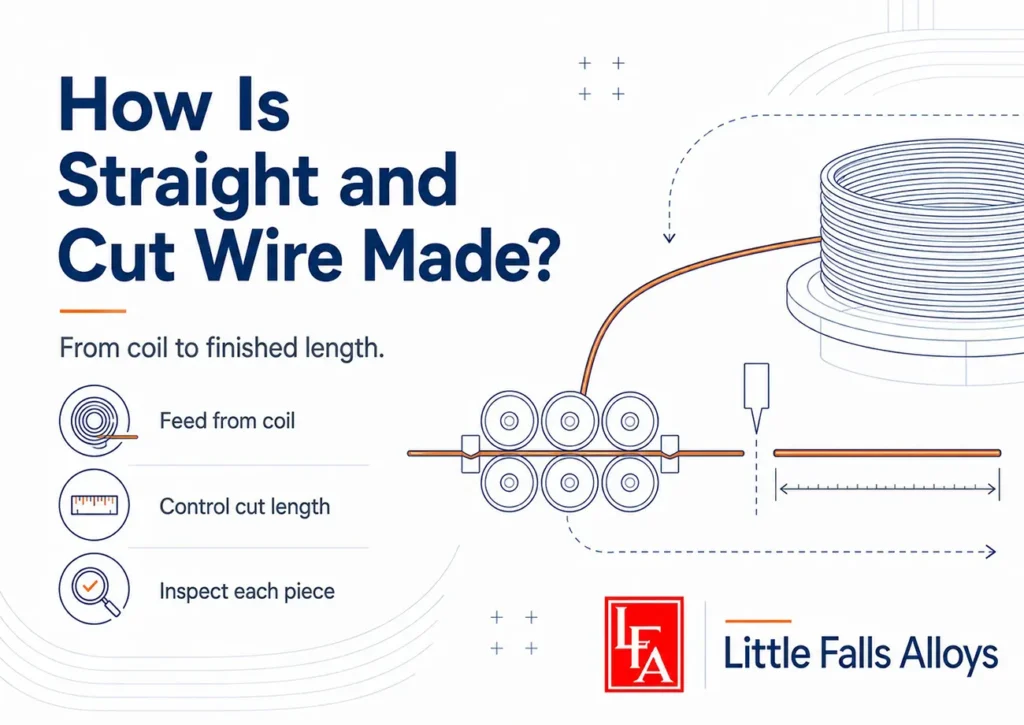
Straightened and Cut Non-Ferrous Wire, Controlled from Start to Finish

July 2, 2026first page

Little Falls Alloys produces straightened and cut non-ferrous wire for customers who need more than wire cut-to-length. Many orders depend on the full condition of the wire before it reaches the final cut piece. Diameter, plating, tensile condition, straightness, length, and tolerance all affect how the finished wire performs in production. Our advantage is simple:…

Read More

When Beryllium Copper Wire Makes Sense for Springs, Contacts, and Conductive Components

May 29, 2026first page

Many copper alloys conduct well. Many spring materials hold force well. Fewer materials do both in the same small component after forming, repeated cycling, heat exposure, and long-term service. Beryllium copper wire is specified when electrical performance and mechanical retention must work together in a single finished part. The main decision is not whether beryllium…

Read More

How Can Plated Wire Prevent Corrosion in Marine, Chemical, and Industrial Settings?

March 29, 2025first page

Enduring Conditions That Demand Strong Defense It’s easy to underestimate how aggressively harsh environments can attack even the sturdiest metals. From salt-laden sea spray to corrosive chemical vapors, conductive wire is constantly at risk of pitting, oxidation, or rust. In settings where failure isn’t just inconvenient but truly costly or dangerous, safeguarding every component becomes…

Read More

Specialized Cross-Sections for Fewer Manufacturing Steps

March 26, 2025first page

It’s always striking how simple geometric changes can spark sweeping improvements in production. One such change appears when shifting from conventional round wire to a shaped form that is square, rectangular, trapezoidal, or even more nuanced in profile. Rather than forcing manufacturers to cut and grind each piece to size, shaped wire arrives with precisely…

Read More

When Excess Wire Becomes a Real Problem

February 27, 2025first page

Have you ever felt overwhelmed by wire offcuts littering the production floor? Those short, discarded pieces might look harmless initially, but they often add to significant expenses. Disposing of them—and the extra time spent remeasuring and cutting—drains resources that could be better used elsewhere. Today’s competitive markets demand lean and efficient workflows. Yet even the…

Read More

How Plated Wire Thickness Changes Wire Performance

February 23, 2025first page

Plating thickness is easy to underestimate because the coating can seem like a final detail rather than an engineering decision. On plated copper and copper alloy wire, the outside layer often controls how the wire behaves in the finished part. A small change in surface thickness can affect contact behavior, solder response, wear life, diffusion…

Read More

Understanding Heat Treatment of Plated Wires

January 25, 2025first page

The idea of “heat treatment” might sound straightforward, but it involves a world of metallurgical science. When it comes to Beryllium Copper wire, controlling how the metal responds to heating and cooling can drastically influence final properties like strength, conductivity, and overall durability. Yet why is this process so central to an alloy that already…

Read More

Why is Beryllium Copper Used as a Base Material for Wires?

January 22, 2025first page

Beryllium Copper is a core material because it successfully combines exceptionally high strength, reliable electrical conductivity, and remarkable fatigue resistance. These characteristics allow it to thrive in demanding environments where repeated stress or mechanical vibration often leads to failure in more conventional metals. Because of its unique blend of properties, Beryllium Copper has become a…

Read More

Advanced Applications of Silver-Plated Wire in High-Frequency Environments

December 24, 2024first page

When high-frequency signals face resistance, the results are clear: slower speeds, weaker performance, and systems that can’t keep up with demands. This isn’t just a minor inconvenience; it can mean lost efficiency, increased costs, or even critical failures in industries like aerospace or telecommunications. High-frequency environments require materials that perform without compromise. Silver-plated wire stands…

Read More

Posts pagination

1 2 3 4 … 6 >
  • Copyright © Little Falls Alloys
  • 171-191 Caldwell Avenue
    Paterson NJ 07501
  • Tel: (973) 278-1666
    Fax: (973) 278-7345
  • Email:sales@lfawire.com
Beryllium Copper Wire | Phosphor Bronze Wire | Nickel Wire | Brass Wire | Copper Wire | Zirconium Copper Wire | Zirconium Chromium Wire | Site Map | Wire Blog
Little Falls Alloys, Inc. is committed to offer top quality straighten and cut wire, plated wire and beryllium copper, Contact Us.