Technical Data




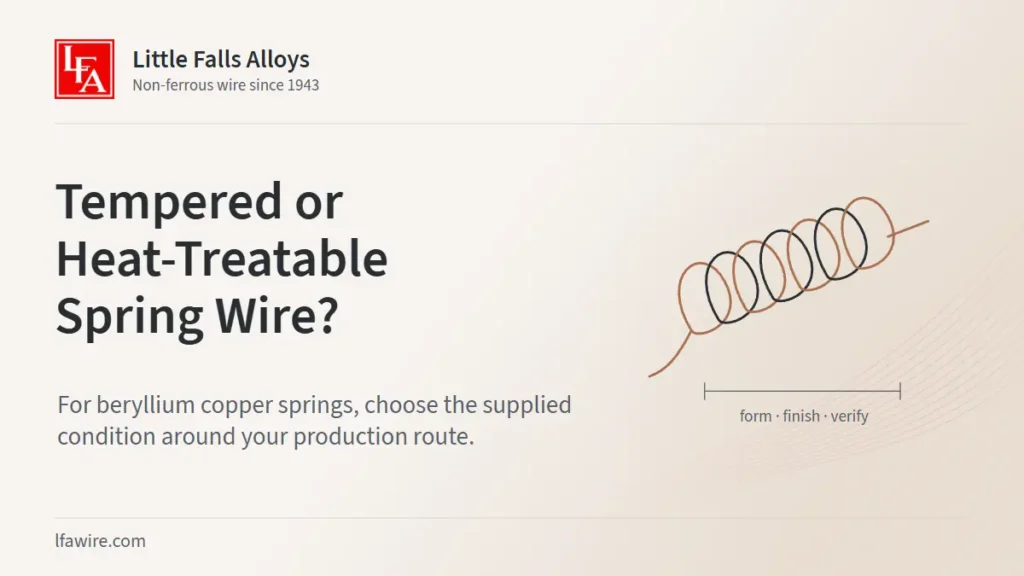
Before ordering beryllium copper wire for a spring, decide how the finished part will obtain its required properties. Will you form heat-treatable wire and then develop the final condition afterward, or use tempered wire through a different production route? The alloy designation alone does not answer that question. Supplied condition belongs in the material decision because it changes the work that follows delivery.
At Little Falls Alloys, we offer heat-treatable Alloy 25 wire and tempered C17200 wire. Our tempered product derives its temper from cold work and was developed for spring coiling without a subsequent precipitation-hardening step. That does not make it interchangeable with every heat-treated spring, nor does it make it the same product as mill-hardened strip. The right starting point is your spring drawing and intended manufacturing sequence.
Two Routes: Different Production Questions
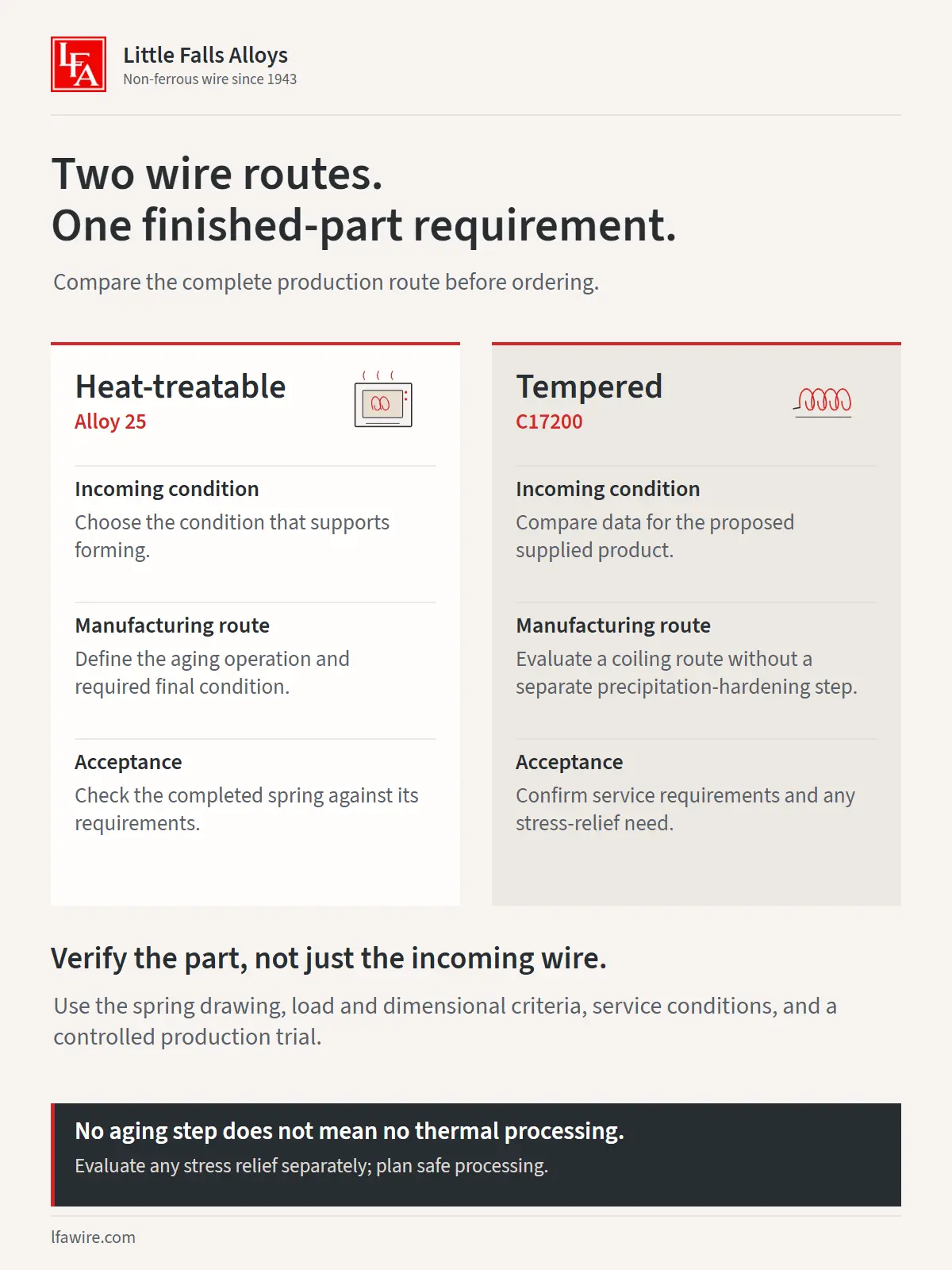
With heat-treatable wire, the supplied condition and subsequent aging process work together. Cold work and age hardening influence the properties developed in copper-beryllium, and the aging response depends on time and temperature. The order should therefore identify the incoming condition while the manufacturing plan defines the required finished condition. A property listed after precipitation treatment should not be treated as the property of untreated incoming wire.
|
Wire route |
Question to resolve before ordering |
|
Heat-treatable Alloy 25 |
Which supplied condition supports forming, and how will the specified final condition be developed and checked afterward? |
|
Tempered C17200 |
Will the supplied product support the proposed forming route and service requirements, and is stress relief or another operation required? |
Our tempered wire offers a route worth considering when a shop wants to avoid a separate precipitation-hardening operation. Service temperature still matters: this cold-work-strengthened product should not simply inherit the temperature capability of heat-treated beryllium copper. Stress relief also remains a separate question. Avoiding age hardening does not mean every spring requires no thermal processing.
Give Us the Requirements That Control the Spring
A request for strong spring wire is too broad to support a useful comparison. For a loaded spring, the drawing and acceptance criteria must specify what the completed part must do. For an electrical contact, the relevant electrical requirements belong alongside the mechanical ones. These priorities narrow the discussion without assuming the highest tensile-strength figure is automatically the best choice.
- Send the alloy requirement, wire cross-section, dimensions, and tolerances. Make clear whether the purchase concerns round, square, or rolled flat wire so the correct product data are compared.
- Describe the forming sequence and equipment constraints. Include planned aging, stress relief, plating or joining instead of discussing the received wire in isolation.
- Identify the finished spring’s load and dimensional requirements. Add operating temperature, repeated movement, or sustained loading where those conditions influence acceptance.
- State the documentation, lot identification, and sampling requirements for the order. Separate required incoming-wire certification from the checks your team will perform on completed springs.
Use data for the proposed form and condition. Our technical information separates wire forms and distinguishes supplied properties from those after treatment. A favorable value from another row does not become a purchasing requirement simply because the alloy name matches. For production, agree on current data and the applicable specification for the wire being quoted.
Compare the Complete Route, Not Just the Spool Price.
Consider a hypothetical spring shop with capable coiling equipment but no approved in-house aging operation. Tempered wire may be worth evaluating because it could remove the need for that operation. The shop still needs to show that the finished spring meets the required load, dimensions, and service conditions. If it does not, an appropriate heat-treatable route with an outside processing provider may be a better choice.
A meaningful trial follows identified material through the planned manufacturing sequence. Record the wire lot and condition, the forming setup, and any subsequent treatment. Measure the completed spring against acceptance limits established before the trial. If an adjustment is needed, include its effect on production effort and repeatability rather than judging the alternative only by the first acceptable sample.
Material suitability and shop capability must both be present. A route that meets the drawing but cannot be controlled consistently is not ready for release. Equally, a convenient process is not enough if its springs miss the application requirements. Select the route on the evidence from the intended finished part, then make the order and work instructions match that choice.
Include Safe Processing in the Plan
Before working with beryllium-containing material, review its current safety data sheet and the controls for the operations you will perform. Airborne beryllium generated during processing can create serious health risks. Have the responsible safety personnel evaluate the process and applicable exposure-control requirements before production, including proposed secondary operations. A material-selection article is not a substitute for that assessment.
Evaluate tempered C17200 when you want to coil the spring without a separate precipitation-hardening step, provided the finished part meets its load, dimensional, and service-temperature requirements. Evaluate heat-treatable Alloy 25 when the approved manufacturing route includes aging to develop the required condition. A shop without an aging operation still has to settle that choice against the spring drawing; convenience alone cannot qualify the tempered alternative. Call Little Falls Alloys at (973) 278-1666 with the drawing, forming sequence, and any planned thermal processing so we can quote the wire condition your production route requires.