Technical Data



The Unseen Friction in High-Speed Automated Wire Forming
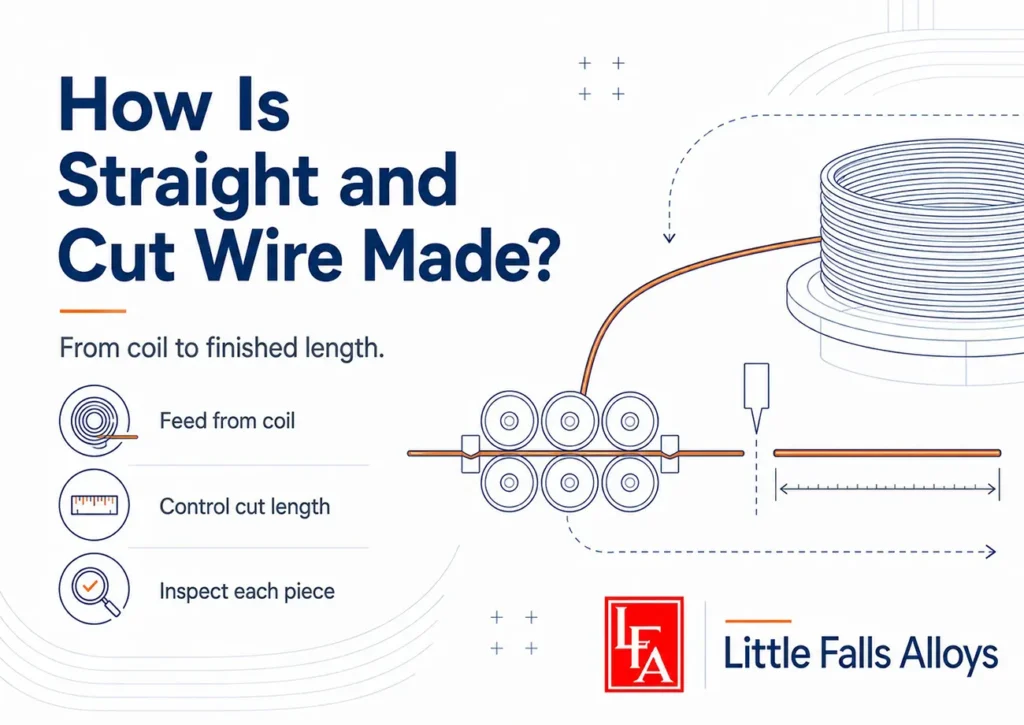
In modern high-speed CNC wire forming, multi-slide stamping, and automated spring winding operations, cycle times are measured in fractions of a second. Production lines frequently feed wire at speeds exceeding one hundred parts per minute. For manufacturing engineers sourcing precision-straightened and cut wire, the single greatest enemy of automated uptime is uncorrected wire memory, which manifests as unwanted camber, cast, and helix. When coiled wire is pulled directly into high-speed benders, residual internal stresses cause wire blanks to wander unpredictably, jamming feed bushings, misaligning forming dies, and generating thousands of out-of-spec scrap parts.
Camber—the continuous slight curvature along the longitudinal length of a wire blank—is not a minor cosmetic imperfection. In automated robotic assembly, a camber deviation of just ten thousandths of an inch across an eight-inch wire pin can cause automated pick-and-place grippers to misalign, triggering immediate production line shutdowns. Achieving true dead-straight wire blanks requires understanding the subtle mechanical physics of rotary arbor stress relief.
The Mechanical Origins of Cast, Helix, and Residual Torsional Stress
When wire is cold-drawn through reduction dies and wound onto storage spools or carrier reels, the material undergoes severe non-uniform plastic deformation. This spooling process embeds two distinct geometric memories in the metal’s crystalline structure.
- Cast (Curvature Memory): Cast represents the natural diameter of the circle formed when a single strand of wire is cut from the spool and laid unrestricted on a flat surface. Tight spools create tight cast, locking deep bending tension into the outer fibers.
- Helix (Torsional Pitch Memory): Helix—frequently termed ‘twist’ or ‘camber roll’—represents the axial vertical rise of the wire ends when laid on a flat inspection plate. This spiral deflection is caused by torsional stresses induced as wire is wound or payed off the edge of a spool.
- Residual Asymmetric Yield Stress: Because the outer radius of coiled wire was stretched in tension while the inner radius was compressed, the wire enters the machine with unbalanced internal stresses that release unpredictably during cutting.
Comparing Wire Straightening Technologies: Rotary Arbor vs. Inline Rollers
| Process Characteristic | High-Speed Rotary Arbor Straightening | Dual-Plane Inline Roller Straighteners | Manual Hand Straightening Fixtures |
| Straightness Tolerance (Camber) | Less than 0.005″ per linear foot (dead straight) | 0.015″ to 0.035″ per foot; retains residual memory | Highly variable; over 0.050″ deviation per foot |
| Stress Neutralization Axis | Full 360-degree helical plastic deformation | Limited to horizontal and vertical planar bends (2 axes) | Uncontrolled localized bending |
| Surface Finish Preservation | Mirror finish with polished carbide or Babbitt dies | Risk of roller tracking marks, flattening, or spiral scuffing | Frequent surface marring and denting |
| End-Cut Precision & Burrs | High-speed planetary shear cut; zero burrs or flash | Chisel guillotine cutoff leaves mushroomed flared ends | Abrasive saw creates heat-affected zone and metal burs |
| High-Speed Automated Feed | Zero feed-tube jams; ideal for automated robotics | Frequent jams due to residual twist and camber roll | Completely unsuitable for automated production |
The Kinematics of Rotary Arbor Straightening: 360-Degree Stress Relief
Dual-plane roller straighteners—which bend wire across an array of staggered upper and lower rollers in horizontal and vertical planes—fail to achieve dead-straight wire blanks because they only address two linear axes. If the wire contains torsional twist (helix), passing through flat rollers merely rotates the camber into an oblique plane.
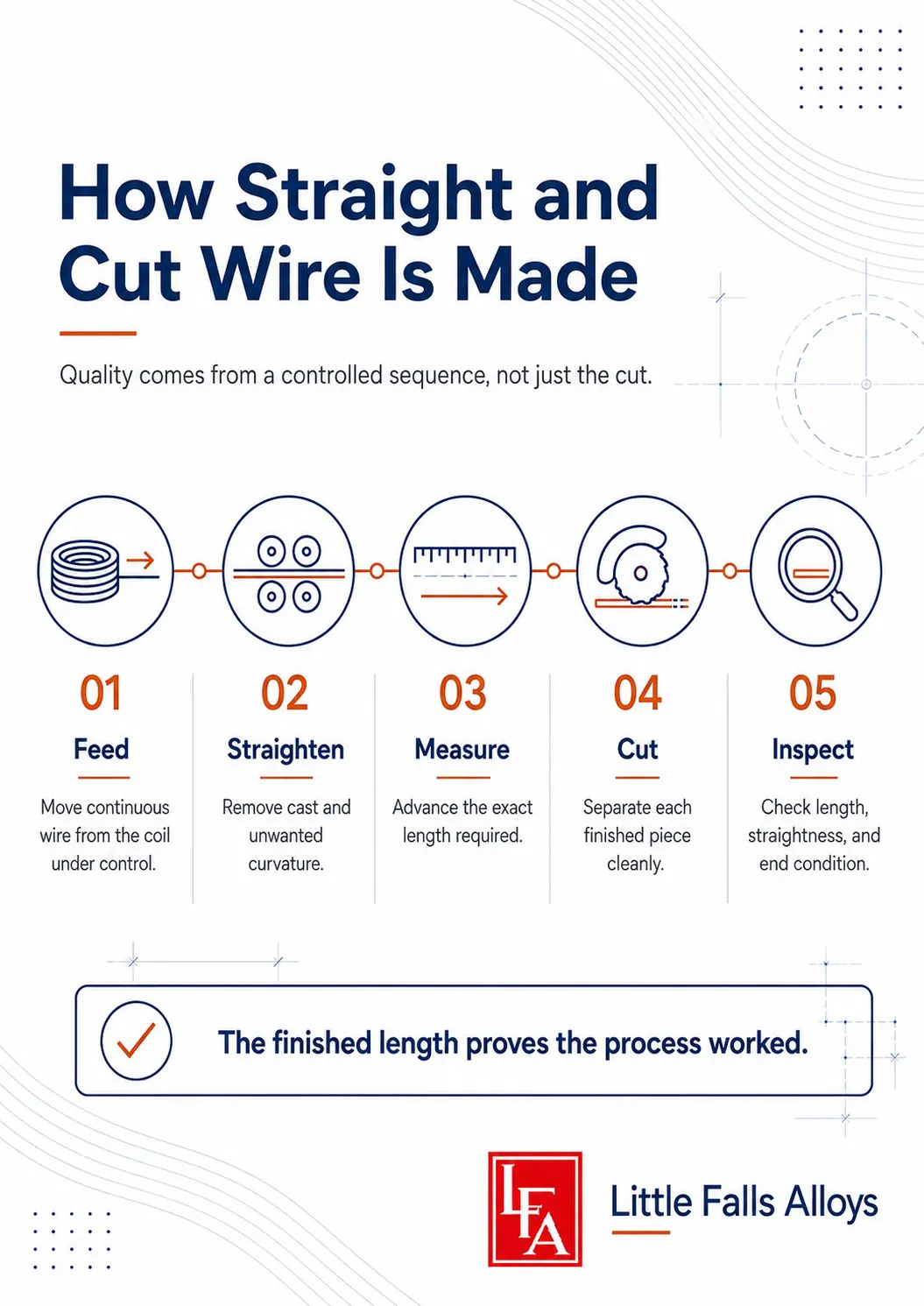
In contrast, specialized rotary arbor straightening machines utilize a rotating barrel housing an array of offset, contoured straightening dies. As the wire is pulled through the arbor, the barrel spins at thousands of revolutions per minute. This high-speed rotation bends the wire back and forth across its yield point in a continuous 360-degree helical wave.
This dynamic mechanical working yields the wire’s outer crystalline grains in all radial directions, completely wiping out the previous spool memory. As the wire exits the arbor, all internal residual stresses are neutralized, producing a perfectly relaxed, dead-straight wire blank that will not curve or twist even when subjected to secondary heat treatment or stamping.
Non-Ferrous Spring Alloys and Arbor Tooling Metallurgy
Straightening specialty non-ferrous alloys requires deep metallurgical customization. High-performance spring alloys like Beryllium Copper (Alloy 25 / C17200) and Phosphor Bronze (C51000) possess high yield strengths and rapid work-hardening tendencies. Running these alloys through standard steel straightening dies causes galling, surface micro-cracking, and severe friction heating.
To preserve critical surface integrity on medical guide wires, switch contacts, and precision aerospace springs, advanced arbor straighteners utilize synthetic polymer, hardened cast iron, or Babbitt bronze dies lubricated with micro-filtered synthetic drawing fluids. This eliminates metal pickup, maintaining ultra-smooth surface finishes (Ra < 8 micro-inches) while achieving absolute straightness.
Predictable Springback in High-Speed Forming Operations
In automated CNC wire forming, the true operational cost of unstraightened wire is unpredictable angular springback. When metal is bent around a forming mandrel, the elastic portion of the strain recovers once the bending force is released. If the incoming wire has fluctuating residual stresses, springback varies from piece to piece—one part springs back 3 degrees, the next springs back 6 degrees.
This forces machine operators to constantly halt automated cells to adjust bend angles, destroying production yields. By feeding rotary-straightened wire blanks with completely homogenized internal stress distributions, springback becomes a 100% predictable mathematical constant. Forming tooling can be dialed in once, allowing CNC benders to run unattended through tens of thousands of parts with zero operator intervention.
Burr-Free Shear Cutting: Protecting Downstream Automated Tooling
Straightness is only half the battle; the cut end condition is equally critical to automated manufacturing efficiency. When wire is cut with dull guillotine blades or abrasive saws, two severe defects occur.
- Mushroomed Flare: Mechanical compression from dull blades expands the wire end diameter beyond its nominal tolerance, causing blanks to jam inside precision feed bushings and collets.
- Jagged Abrasive Burrs: Abrasive saw cuts leave razor-sharp metal flash and microscopic particulate that shed inside delicate tooling, gouging expensive progressive stamping dies.
High-precision straighten and cut machines utilize synchronized high-speed quill shear dies. The wire is supported continuously within precision tungsten carbide bushings right up to the shear point, eliminating tooling chatter and preventing micro-deflection. The cutting stroke delivers a clean, perpendicular, burr-free square cut with minimal end distortion, ensuring seamless automated feeding.
Quality Inspection: Laser Micrometer Sorting and Length Tolerances
Precision manufacturing operations require strict cut-length consistency. Advanced straighten and cut lines integrate high-speed non-contact laser micrometers that measure each wire blank in flight, verifying cut lengths to within plus or minus two thousandths of an inch (±0.002″). Out-of-spec blanks are pneumatically ejected, guaranteeing that only flawless wire reaches automated assembly collets.
Driving Unattended Productivity in Automated Manufacturing
In competitive contract manufacturing and precision component fabrication, profitability depends directly on spindle uptime and unattended machine cycles. Forcing operators to pause high-speed CNC benders every twenty minutes to clear jammed wire feeds or manually tweak roller straighteners destroys production margins.
By specifying precision rotary-straightened and cut wire blanks engineered to strict camber and length tolerances, manufacturers achieve uninterrupted, lights-out production. Sourcing dead-straight wire blanks in specialty non-ferrous, beryllium copper, phosphor bronze, or nickel alloys ensures flawless forming accuracy, eliminates scrap, and keeps automated production lines running at peak velocity.