

Phone:973-278-1666
Email:sales@lfawire.com
Technical Data
Menu
  • Home
  • About
  • Wire
    • Beryllium Copper Wire
      • Heat Treatable, Alloy 25 (C17200 and C17300)
      • Tempered, Alloy 25 (C17200)
    • Nickel Wire
      • 80-20 Copper-Nickel C71000
      • COPPER-NICKEL-TIN C72500
      • Nickel 205 Grade A
    • Phosphor Bronze Wire
      • Phosphor Bronze, C51000 Grade A
      • Phosphor Bronze C52100 Grade C
      • Phosphor Bronze, C50700 Grade E
    • Brass Wire
      • 70-30 Brass, C26000
    • Copper Wire
      • Copper, Oxygen Free High Conductivity C10200
      • Copper, C11000, ETP
      • Zirconium Copper Wire
    • Copper Alloy Wire
      • C 18080 K-88 Alloy
      • C 18150 Copper Chromium Zirconium (ZCC)
  • Plating
  • Straight And Cut Wire
  • Request Quote
  • Sales Terms
  • Contact
  • Chinese Catalog
CLOSE

Author: admin

Home Articles Posted by admin (Page 3)
104 posts, 0 comments

The Differences Between Soldering, Brazing, and Welding

August 23, 2020admin

Brazing and soldering are commonly used as essential assembly techniques. Because you are working with a precipitation hardening alloy, temperature and heat time may be standardized and controlled. Welding is known to offer specific advantages that other structural alloys do not. This is especially the case for cold work strength. Welded joints made with copper…
Read More

Cleaning Options for Beryllium Copper Wire

August 13, 2020admin

Copper beryllium has many desirable joining and plating characteristics. Because the alloy is used in precision applications, their surface cleanliness is a critical factor when plating wire or joining by bronzing, soldering, and welding. Any foreign substance, including grease, oil, paint, dirt, dust, and oxide must be removed before plating and joining operations are performed….

Read More

Plated Wire and the Principles of Electroplating

August 4, 2020admin

The process of plating a metal on another metal is called electroplating. It is done by hydrolysis, and it is most commonly done to enhance corrosion resistance. An electrical current is used to reduce dissolved cations to develop a lean and coherent metal coating (on the electrode). When you are interested in modifying the surface…

Read More

Understanding the Differences Between Coil and Box Wires

July 28, 2020admin

Although there are many similarities between coil and box wires, they should be used to fill different needs. Understanding the unique advantages that each offer helps you to make the smart choice for your next project. Below, we want to take the time to go over the main differences between the two wire types. Box…

Read More

The Capabilities of Straight and Cut Wire

June 26, 2020admin

Straightened and cut wires accommodate a broad range of grades, material, and size to meet varying customer needs. Regardless of small or large production runs, modern production equipment achieves cut and strengthen needs that have quick turnaround times and high production quality. Two straightening and cutting operations are performed to accommodate the various needs of…

Read More
Straight and cut wire

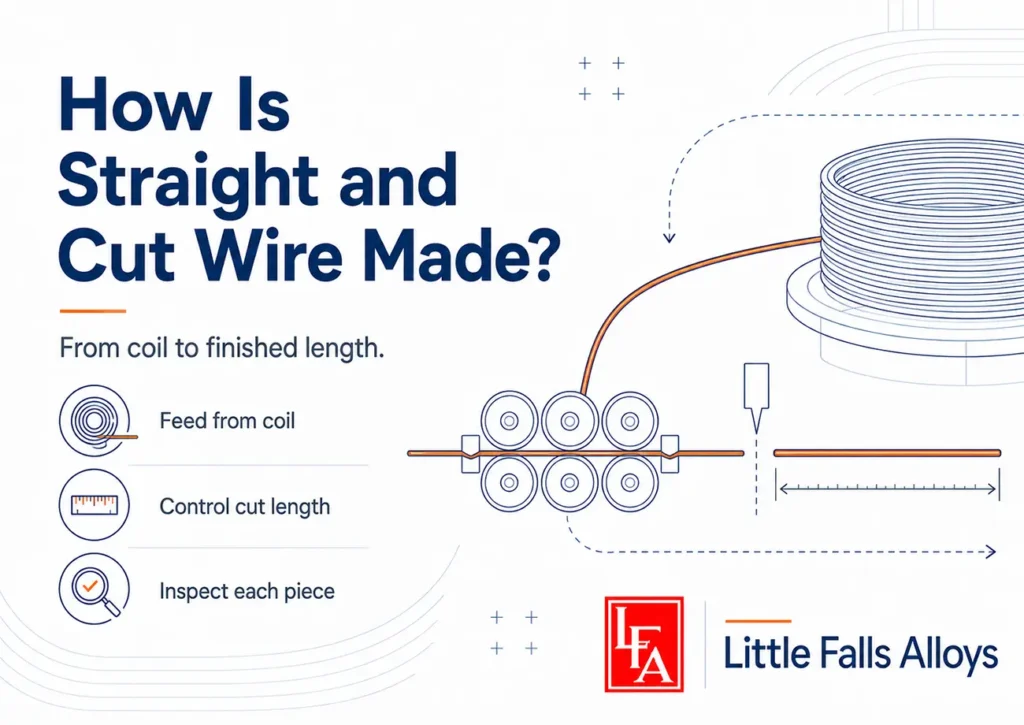
How Straight and Cut Wire Is Made

June 3, 2020admin

Straight and cut wire is produced by taking continuous coiled wire, removing unwanted curvature, advancing a controlled amount of material, and cutting it to the required finished length. Although the sequence is straightforward, the quality of the finished piece depends on more than just the cutting operation. Feeding controls how the material moves through the…

Read More

Copper and Nickel-Beryllium

May 25, 2020admin

Copper-beryllium alloys offer users a combination of electrical and mechanical properties. The mechanical strengths achieved as a result of heat treatment ranks amongst the highest of all copper alloys. It has a reliable electrical conductivity that is known to outperform materials like bronze. To meet the strict demands of electrical engineering, we offer a full-range…

Read More

What Makes Phosphor Bronze Wires Unique?

April 30, 2020admin

Have you considered using phosphor bronze wires? There are many reasons that engineers and manufacturers hold this material in such high esteem. Simply put, they are unique. Phosphor bronze is considered a bronze alloy that consists of a mixture of tin, copper, phosphorous, lead, and zinc. Although there are many applications for the material, it…

Read More
Beryllium Copper Wire

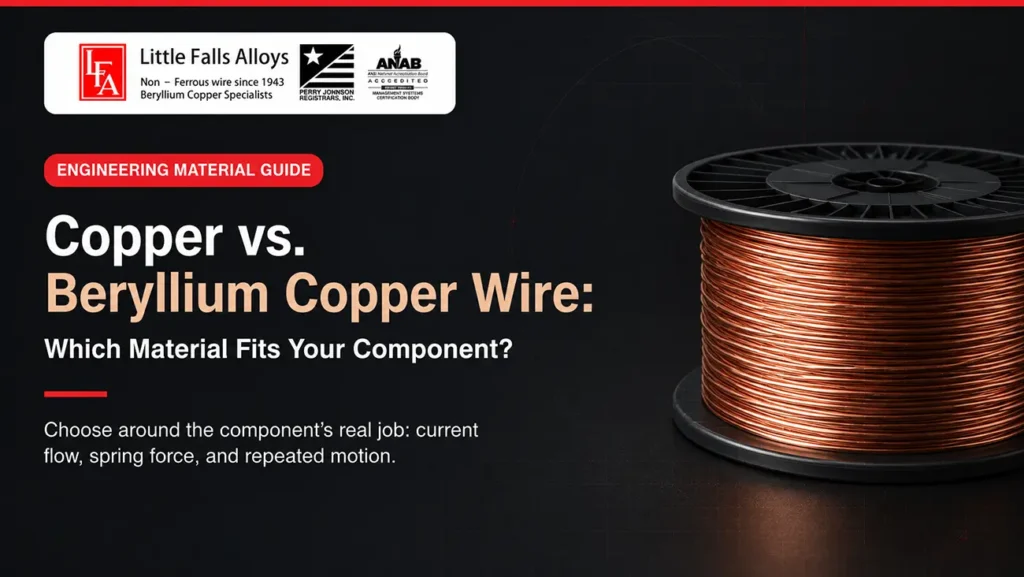
Copper vs. Beryllium Copper Wire: Which Material Fits Your Component?

April 6, 2020admin

Electrical conductivity alone does not determine whether wire will perform inside a contact, spring, connector, or formed component. A material might carry the required current yet bend permanently, lose contact force, or fracture after repeated movement. Pure copper and beryllium copper both serve electrical applications, but each solves a different design problem. The correct choice…

Read More

The Benefits of Using Tinned Copper Wire

March 27, 2020admin

Without a doubt, there are many advantages found when using tinned copper as opposed to bare copper. The more time someone takes learning about what tinned copper is, the more they will realize that it is a valuable material. Tin is electroplated onto copper to create tinned copper. The base alloy is coated with tin…

Read More

Posts pagination

< 1 2 3 4 5 6 … 11 >
  • Copyright © Little Falls Alloys
  • 171-191 Caldwell Avenue
    Paterson NJ 07501
  • Tel: (973) 278-1666
    Fax: (973) 278-7345
  • Email:sales@lfawire.com
Beryllium Copper Wire | Phosphor Bronze Wire | Nickel Wire | Brass Wire | Copper Wire | Zirconium Copper Wire | Zirconium Chromium Wire | Site Map | Wire Blog
Little Falls Alloys, Inc. is committed to offer top quality straighten and cut wire, plated wire and beryllium copper, Contact Us.